
Flagship Programme
Anomaly detection
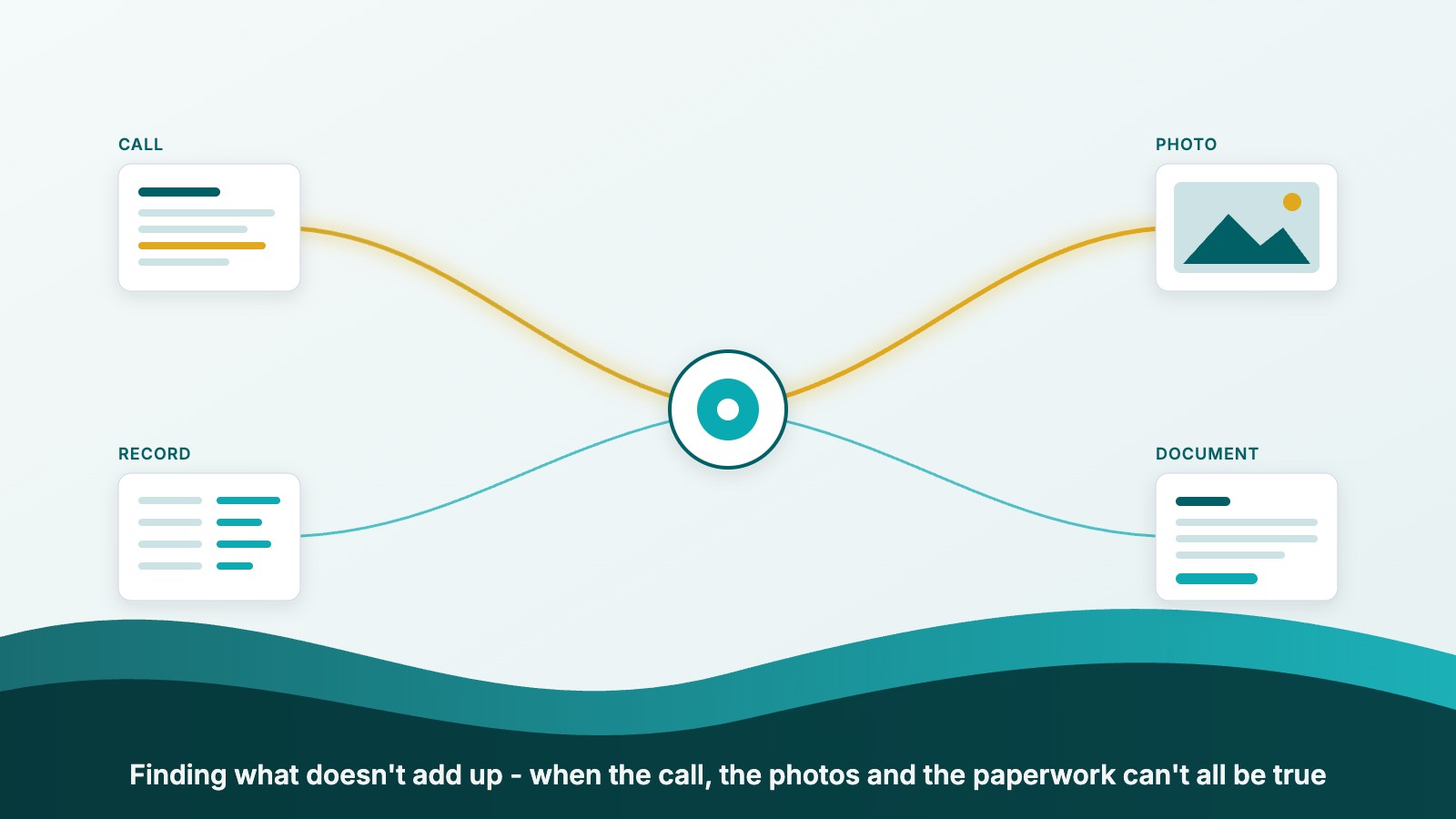
Finding what doesn't add up — when the call, the photos and the paperwork can't all be true.
Why this programme
The challenge we are addressing
As insurers automate, more decisions are made from structured fields alone. But the evidence that something is wrong usually sits in the material around those fields: a phone call, a photograph, a note, a document. A caller says they were stationary; the photos show angled damage to the front corner. Neither is wrong by itself. An experienced handler spots this in seconds, and nobody ever wrote a rule for it. Off-the-shelf "anomaly detection" looks for outliers in single metrics and misses this entirely. When the person leaves the loop, so does the noticing, unless we rebuild it.
Our vision
Every automated decision gets the scrutiny a good expert would have given it: all the evidence weighed together, contradictions brought to the surface, and the reasoning shown.
Our distinctive position
We mean something specific by anomaly: a contradiction you can only see across several sources of evidence, and one that changes a real decision. You cannot buy this as a cloud feature. What platforms sell as anomaly detection is statistics on single metrics. Our work starts inside real insurance operations, in claims, fraud and risk, with live data, real workflows and somewhere to deploy. From there we build the hard parts once: reading calls, documents, images and records as a single account, and testing that account for what cannot hold together. Oxford's research community is a short walk away.

Bernardo Perez Orozco
Director of AI delivery

Anand Ramkumar
Machine learning scientist
Patrick Tunney
Machine learning scientist

Diego Cervera
Machine learning scientist
Francesca Ronci
Machine learning scientist
Alex Constantin
Project lead & machine learning engineer
Steph Clacksman
Senior software engineer
Team
The people leading and supporting this programme.